| I was curious whether my laptop is damaged by unknown reason or not, because its memory usage is 51% even though I haven't ran any app. The reason why I thought like that was because my laptop network was sometimes malfunction even though the Wifi connection was successfully established. Later, it turned out that was caused by abnormal behavior of DHCP for DNS(Domain Name Service). To make long story short, the network issue was different issue and caused by Cox. By the way, below is the captured screen for my task maanager on Microsoft Windows. 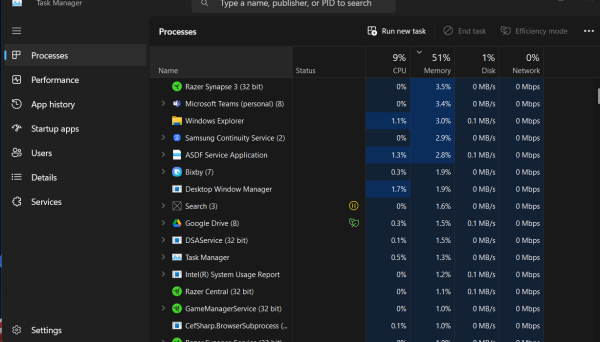
I had some research if above is really a normal and learned following information: A memory usage of 51% on a Windows system without actively running applications can be normal depending on several factors such as the total amount of RAM installed, the number of background processes and services running, and the operating system's memory management behavior. Here are some steps to minimize memory usage: - Check Startup Programs:
- Press
Ctrl + Shift + Esc to open Task Manager. - Go to the "Startup" tab.
- Disable any unnecessary programs that start with Windows.
- Check Background Processes:
- In Task Manager, under the "Processes" tab, check for background processes using significant memory.
- Identify and close unnecessary processes.
- Adjust Visual Effects:
- Right-click on "This PC" or "Computer" on the desktop or in File Explorer.
- Select "Properties" → "Advanced system settings."
- Under the "Performance" section, click "Settings."
- Select "Adjust for best performance" or customize which visual effects to disable.
- Reduce Running Services:
- Press
Win + R, type msconfig, and press Enter. - Go to the "Services" tab.
- Check "Hide all Microsoft services" to avoid disabling essential services.
- Disable any unnecessary third-party services.
- Uninstall Unnecessary Programs:
- Go to "Control Panel" → "Programs" → "Programs and Features."
- Uninstall programs you no longer use or need.
- Update Windows and Drivers:
- Ensure your Windows and drivers are up to date, as updates can include performance improvements and bug fixes.
- Scan for Malware:
- Use a reputable antivirus or antimalware program to scan for and remove any malware that might be using system resources.
- Increase Virtual Memory:
- Right-click on "This PC" or "Computer" → "Properties."
- Select "Advanced system settings" → "Settings" under the Performance section.
- Go to the "Advanced" tab and click "Change" under Virtual memory.
- Adjust the size of the paging file to improve performance.
If you've tried these steps and are still experiencing high memory usage, providing additional details such as the amount of installed RAM and specific background processes using memory might help in diagnosing the issue further. |