AI Engineering is a multi-faceted discipline focused on building, deploying, and maintaining AI systems at scale in a reliable and efficient way. Think of it as taking AI models (like LLMs, image recognition systems, etc.) and turning them into practical, real-world applications that can handle user traffic, data changes, and the complexities of a production environment. It's about making AI work in the real world.
Here's a more detailed breakdown:
Focus on the AI Lifecycle: AI Engineering encompasses the entire AI lifecycle, from data acquisition and preparation to model deployment, monitoring, and retraining. It doesn't just stop at creating a model.
Scalability and Reliability: AI Engineers ensure that AI systems can handle large volumes of data, users, and requests without failing or becoming prohibitively slow. They consider infrastructure, optimization, and robust testing.
Maintainability and Monitoring: AI systems need to be constantly monitored for performance degradation, data drift, and potential biases. AI Engineers build systems that allow for easy updates, bug fixes, and retraining.
Automation: AI Engineering often involves automating various aspects of the AI lifecycle, such as data preprocessing, model training, and deployment, to improve efficiency and reduce manual intervention.
DevOps Principles: AI Engineering borrows heavily from DevOps principles, emphasizing collaboration between data scientists, software engineers, and operations teams.
Practical Application: The ultimate goal is to create AI-powered products and services that solve real-world problems and deliver business value. Examples include:
Building a fraud detection system for a bank.
Creating a personalized recommendation engine for an e-commerce website.
Developing an AI-powered chatbot for customer support.
Deploying a computer vision system for quality control in a manufacturing plant.
Now AI Engineering is the Main Stream!
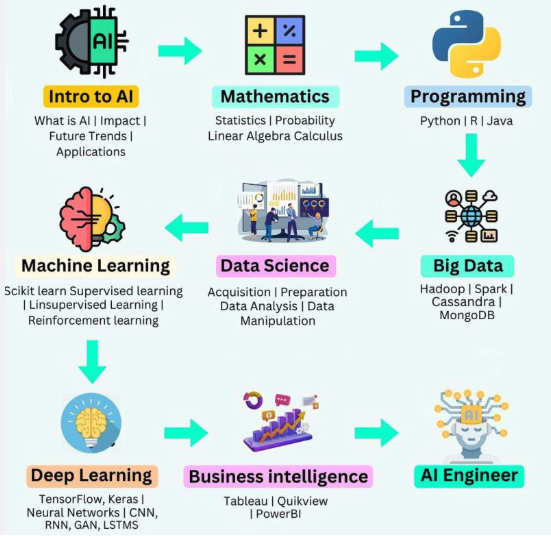
The introduction of AI several years ago sparked a surge in mathematics study, followed by coding in languages like Python, R, and Java, which then transitioned into big data and subsequently data science, naturally leading to a machine learning craze. This trend then evolved into deep learning, business intelligence, and ultimately, the current focus on AI Engineering, indicating that now is the time to concentrate on this area.
How AI Engineering Differs from Inventing LLMs
The key difference is focus.
Inventing LLMs: This is primarily the domain of research scientists, machine learning researchers, and deep learning experts. It's about:
Developing new model architectures: Coming up with fundamentally new ways for neural networks to learn and process language. Think of the original Transformer architecture (which powers many LLMs).
Improving training algorithms: Finding more efficient and effective ways to train LLMs on massive datasets.
Pushing the boundaries of AI: Trying to make LLMs more intelligent, creative, and capable.
Research-driven: The work is primarily driven by scientific curiosity and the desire to advance the state of the art in AI.
Example: A team at Google or OpenAI working on a new version of BERT or GPT that has significantly improved performance and capabilities.
AI Engineering: This is the domain of software engineers, data engineers, DevOps engineers, and machine learning engineers. It's about:
Taking existing LLMs (or other AI models) and putting them to work in real-world applications.
Integrating LLMs into larger systems: Connecting LLMs to databases, APIs, and other services.
Optimizing LLMs for performance: Making LLMs run faster and more efficiently on the available hardware. This might involve techniques like model quantization, pruning, or distillation.
Ensuring the reliability and security of LLM-powered applications.
Production-focused: The work is primarily driven by practical needs and the desire to build useful products.
Example: Building a customer service chatbot that uses an existing LLM to understand and respond to customer inquiries. Or, creating an AI-powered code completion tool that leverages an LLM.
Full-Stack Engineer vs. AI Engineer: A Comparison
A Full-Stack Engineer is a versatile developer proficient in both front-end and back-end technologies, capable of handling all aspects of application development from user interface design and client-side scripting to server-side logic, database management, and API development, ensuring a cohesive and functional user experience.
Feature
Full-Stack Engineer
AI Engineer
Core Focus
Building and maintaining complete web applications (front-end, back-end, databases, servers).
Building, deploying, and maintaining AI/ML models and systems.
Responsibilities
- Designing and developing user interfaces (front-end). - Building server-side logic and APIs (back-end). - Managing databases and infrastructure. - Ensuring application scalability and performance. - Writing clean, testable, and efficient code. - Collaborating with designers, product managers, and other developers.
- Developing and training AI/ML models. - Deploying models to production environments. - Monitoring model performance and retraining as needed. - Developing data pipelines for model training and inference. - Working with large datasets. - Researching and implementing new AI/ML techniques.
Key Skills
- Front-End: HTML, CSS, JavaScript (React, Angular, Vue.js), UI/UX principles. - Back-End: Python, Java, Node.js, Ruby, PHP, databases (SQL, NoSQL), APIs, server management, cloud technologies (AWS, Azure, GCP). - Version control (Git). - Testing and debugging. - Problem-solving.
- Programming: Python (essential), Java, R, C++. - Machine Learning: Supervised learning, unsupervised learning, deep learning, reinforcement learning. - Deep Learning Frameworks: TensorFlow, PyTorch, Keras. - Data Science Tools: NumPy, Pandas, Scikit-learn. - Data Engineering: Data pipelines, ETL processes, big data technologies (Spark, Hadoop). - Cloud Computing: AWS, Azure, GCP (for deploying models). - Mathematics & Statistics: Linear algebra, calculus, probability, statistics.
Education/Background
- Bachelor's degree in Computer Science or a related field. - Bootcamp or self-taught with a strong portfolio.
- Master's degree or PhD in Computer Science, Machine Learning, Statistics, or a related field (often preferred). - Strong background in mathematics and statistics.
Typical Projects
- E-commerce websites. - Social media platforms. - Content management systems. - Web applications for businesses.
Generally high, depending on experience, location, and company.
Generally very high, often higher than Full-Stack Engineers, due to the specialized skills.
Job Market
High demand, lots of opportunities.
Extremely high demand, rapidly growing field.
Day-to-Day Work
Building and maintaining web features, writing code, debugging, collaborating with team members, attending meetings.
Training models, evaluating performance, deploying models, writing code, working with data, reading research papers.
Learning Curve
Continuous learning is essential, but the fundamentals are relatively accessible.
Steeper learning curve, requires strong mathematical and statistical foundation. Constant learning of new research and technologies.
Impact
Directly impacts user experience and business operations through the functionality of web applications.
Impacts decision-making, automation, and prediction through AI-powered systems.
Similarities:
Problem-Solving: Both roles require strong problem-solving skills to identify and fix issues.
Coding: Both roles involve a significant amount of coding.
Collaboration: Both roles require effective collaboration with other team members.
Continuous Learning: Both fields are constantly evolving, requiring ongoing learning to stay up-to-date.
Understanding of Software Development Lifecycle: Both need a good understanding of how software is built, tested, and deployed.
Why are AI Engineers in High Demand?
The demand for AI Engineers is surging due to several key factors:
AI is Moving from Research to Production: Many organizations have invested in AI research and experimentation, and now they need skilled professionals to translate those research results into real-world applications that generate business value.
Complexity of AI Systems: AI systems are often complex and require specialized expertise to deploy, manage, and maintain. It's not enough to just have a trained model; you need to build the entire infrastructure and processes around it.
Need for Scalability and Reliability: Organizations need AI systems that can handle large volumes of data and user requests without failing. AI Engineers are crucial for ensuring scalability, reliability, and performance.
Data Explosion: The ever-increasing amount of data requires efficient and scalable AI solutions to extract insights and automate processes.
Competitive Advantage: Companies that can effectively leverage AI have a significant competitive advantage. They need AI Engineers to build and deploy these AI-powered solutions.
Cost Optimization: AI engineers help to optimize the cost of running AI workloads, for example by implementing auto-scaling and utilizing cost-effective cloud resources.
The Rise of LLMs and Generative AI: The recent advances in LLMs and generative AI have created a massive demand for engineers who can build applications powered by these technologies. Every company wants to leverage these powerful tools, and they need AI Engineers to do so.
What Should You Learn if You're Interested in AI Engineering?
The skills required for AI engineering are broad and overlap with many areas of software engineering and data science. Here's a roadmap:
1. Foundational Programming Skills:
Python: The dominant language in the AI/ML world. Become proficient in it.
Data Structures and Algorithms: Essential for writing efficient code.
Object-Oriented Programming (OOP): Important for designing and building complex systems.
2. Machine Learning Fundamentals:
Basic ML Concepts: Supervised learning, unsupervised learning, reinforcement learning.
Model Evaluation: Metrics for assessing model performance (e.g., accuracy, precision, recall, F1-score, AUC).
Common ML Algorithms: Linear regression, logistic regression, decision trees, support vector machines, k-means clustering. (You don't need to become an expert on all of these, but understand their strengths and weaknesses.)
3. Deep Learning (Especially if you want to work with LLMs):
Deep Learning Frameworks: PyTorch and TensorFlow are the most popular. Choose one and become proficient in it. PyTorch is generally favored for research and flexibility, TensorFlow for production deployment.
Training Deep Learning Models: Backpropagation, optimizers (e.g., Adam, SGD), regularization techniques (e.g., dropout, weight decay).
Working with Pre-trained Models: Hugging Face Transformers library is essential for working with pre-trained LLMs.
4. Data Engineering:
Data Acquisition and Preprocessing: Collecting data from various sources, cleaning data, and transforming it into a format suitable for machine learning.
Data Storage: Databases (SQL and NoSQL), data lakes (e.g., Hadoop, Spark), cloud storage (e.g., AWS S3, Azure Blob Storage, Google Cloud Storage).
Data Pipelines: Tools for building and managing data pipelines (e.g., Apache Airflow, Apache Beam, Luigi).
Feature Engineering: Selecting and transforming features to improve model performance.
5. Cloud Computing:
Cloud Platforms: AWS, Azure, and Google Cloud Platform (GCP) are the major players. Learn the basics of one of them, including:
Containerization: Docker is essential for packaging and deploying AI applications.
Orchestration: Kubernetes is the leading container orchestration platform.
6. DevOps:
Continuous Integration/Continuous Deployment (CI/CD): Automating the build, test, and deployment process.
Version Control: Git is essential for managing code changes.
Infrastructure as Code (IaC): Tools like Terraform or CloudFormation for automating the provisioning of infrastructure.
Monitoring and Logging: Tools for monitoring the performance of AI applications and logging errors.
7. Model Deployment and Management:
Model Serving: Tools for deploying and serving AI models (e.g., TensorFlow Serving, TorchServe, FastAPI, Flask).
Model Monitoring: Tools for monitoring model performance, detecting data drift, and triggering retraining.
Model Versioning: Keeping track of different versions of models.
A/B Testing: Comparing different models to see which performs best.
8. Specific to LLMs (if you want to specialize):
Natural Language Processing (NLP) Fundamentals: Tokenization, stemming, lemmatization, part-of-speech tagging, named entity recognition.
Transformer Architectures: Understand the inner workings of Transformer models.
Fine-tuning LLMs: Adapting pre-trained LLMs to specific tasks.
Prompt Engineering: Crafting effective prompts for LLMs.
LLM Evaluation Metrics: BLEU, ROUGE, perplexity.
Responsible AI: Understanding and mitigating biases and ethical concerns in LLMs.
9. Software Engineering Principles:
Testing (Unit, Integration, End-to-End)
Code Readability and Maintainability
Design Patterns
Where to Start Learning?
Online Courses:
Coursera, edX, Udacity, fast.ai offer excellent courses on machine learning, deep learning, and AI engineering.
Andrew Ng's Machine Learning course on Coursera is a great starting point.
Deeplearning.ai offers specialized courses on deep learning and NLP.
Books:
"Hands-On Machine Learning with Scikit-Learn, Keras & TensorFlow" by Aurélien Géron
"Deep Learning" by Ian Goodfellow, Yoshua Bengio, and Aaron Courville
"Designing Machine Learning Systems" by Chip Huyen
Projects:
Start with small projects, such as building a simple image classifier or a text summarization tool.
Contribute to open-source AI projects.
Participate in Kaggle competitions.
Important Considerations:
Specialize: AI Engineering is a broad field. You don't need to know everything. Pick a specialization (e.g., computer vision, NLP, reinforcement learning) and focus on developing expertise in that area.
Stay Up-to-Date: The field of AI is constantly evolving. Read research papers, attend conferences, and follow industry blogs to stay up-to-date on the latest developments.
Focus on Practical Skills: Employers value practical skills over theoretical knowledge. Focus on building projects and gaining hands-on experience.
AI Engineering is a crucial field for deploying and scaling AI models in the real world. The demand for AI Engineers is high, and a combination of programming, machine learning, data engineering, MLOps, and cloud computing skills is essential to succeed in this role. Good luck!
By focusing on these areas, you'll be well on your way to becoming a successful AI Engineer! Good luck!