Bootstrap vs. Tailwind CSS: Origins, Features, Pros & Cons, and How to Choose the Right Framework
JK 2026 Created at Updated at
18200
Why Compare Bootstrap and Tailwind CSS?
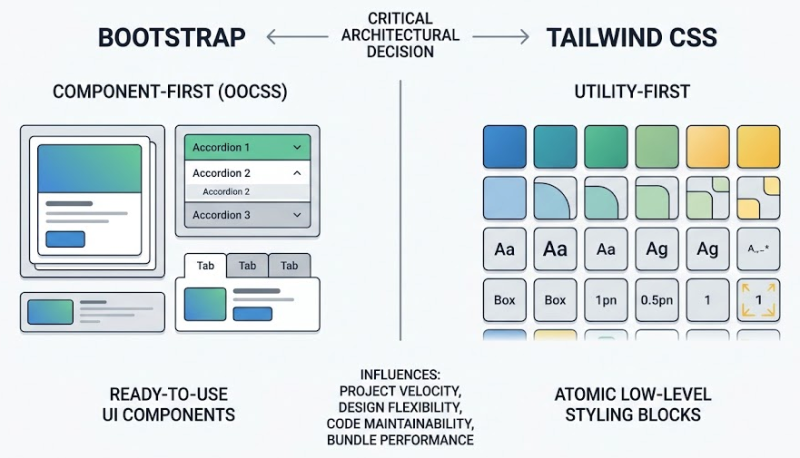
In modern web development, choosing the right CSS framework is a critical architectural decision that directly influences project velocity, design flexibility, code maintainability, and bundle performance.
Bootstrap and Tailwind CSS represent the two dominant, yet fundamentally opposing, paradigms in styling web applications:
Tailwind CSS follows a Utility-First approach, offering atomic low-level styling blocks that developers compose directly in their markup.
Comparing these two frameworks helps developers and technical leads select the tool that best aligns with their team's design requirements, technical expertise, and project scale.
Birth Background and History
1. Bootstrap
Background
Bootstrap was created in mid-2010 at Twitter by developers Mark Otto and Jacob Thornton. Prior to Bootstrap, Twitter developers used various in-house libraries to style tools, leading to high inconsistency, maintenance burdens, and onboarding friction. Bootstrap was initially developed as an internal standard called "Twitter Blueprint" to solve these internal alignment issues.
History & Milestones
2011 (Release): Open-sourced in August 2011. It quickly became the most popular CSS framework on GitHub due to its user-friendly grid system.
2012 (v2.0): Added a responsive 12-column grid system, making mobile-responsive design mainstream.
2013 (v3.0): Redesigned with a Mobile-First strategy, catering to the booming smartphone market.
2018 (v4.0): Rewritten to use Flexbox under the hood, introducing rewritten utilities and dropping support for older IE versions.
2021 (v5.0): Dropped its dependency on jQuery entirely in favor of vanilla JavaScript, switched to native CSS custom properties (variables), and improved modularity.
2. Tailwind CSS
Background
Tailwind CSS was created by Adam Wathan around 2017. Wathan noticed that while building complex web application interfaces, writing traditional custom CSS classes (such as BEM notation) led to massive, bloated stylesheets, frequent file-switching, and continuous naming fatigue ("What do I name this wrapper div?"). He envisioned an atomic CSS engine that would allow styling interfaces rapidly without leaving the HTML/JSX files.
History & Milestones
2017 (Inception): Released as an open-source side project born out of Wathan's experimentations in utility-first CSS patterns.
2019 (v1.0): Official major release with a robust configuration engine (tailwind.config.js) allowing custom design system definitions.
2020 (v2.0): Added dark mode support, an expanded color palette, and initial experimental Just-In-Time (JIT) capabilities.
2021 (v3.0): Introduced the JIT compiler as the standard engine, enabling dynamic arbitrary value generation (e.g., w-[123px]) and significantly reducing build speeds and bundle sizes.
Overriding Difficulty: Overriding default styles requires writing custom CSS that often fights with Bootstrap's specificity, leading to !important tags or bloated CSS overrides.
Ultimate Design Freedom: No opinions on visual appearance; craft unique, highly customized user interfaces.
No Class Naming Fatigue: Eliminates the need to invent semantic class names like .card-body-wrapper-inner.
High Performance: Unused CSS is automatically stripped out in production; styles scale with unique utility usage, not application size.
Seamless Developer Experience (DX): Write HTML/JSX and styles simultaneously without switching files.
Cons
Steep Learning Curve: Requires memorizing hundreds of utility class names and understanding fundamental CSS properties.
Cluttered HTML Markup: HTML files can become visually noisy with dozens of utility classes on a single element (e.g., class="flex items-center justify-between p-4 bg-white shadow-md rounded-lg").
No Default Component Styles: Buttons, modals, and navbars must be built from scratch or copied from component libraries (e.g., Tailwind UI, Shadcn UI).