Telemetry vs. Analytics: Understanding the Difference and Why It Matters
JK 2022 Created at Updated at
26200
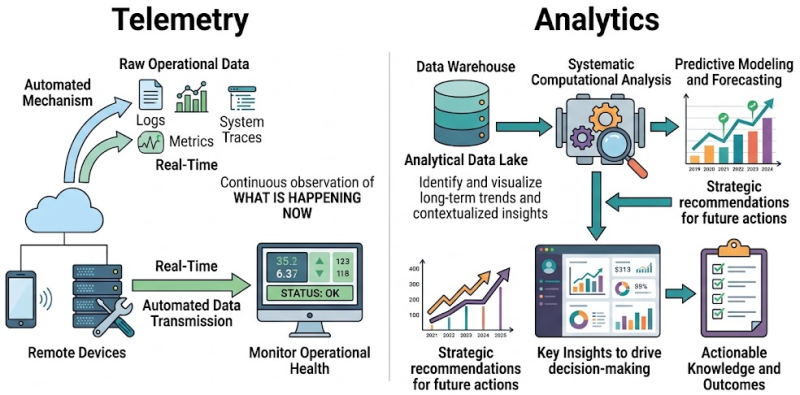
Telemetry and analytics are fundamentally different in their purpose and scope, with telemetry acting as the automated mechanism for capturing and transmitting raw operational data—such as logs, metrics, and system traces—from remote devices or applications in real time to monitor operational health. In contrast, analytics is the process of examining, aggregating, and interpreting that collected data to extract meaningful insights, identify long-term trends, and support strategic decision-making. While telemetry focuses on the continuous observation of what is happening technically right now, analytics contextualizes that information to understand why it happened and what actions should be taken for future optimization.
What is Telemetry?
Telemetry is the automated process of collecting operational data from remote, distributed, or inaccessible systems and transmitting it to a centralized location for monitoring, analysis, and storage. The term derives from the Greek roots tele (remote) and metron (measure).
In modern software, cloud computing, and hardware engineering, telemetry serves as the foundational data-gathering layer that provides visibility into how a system is performing in real time.
Key Characteristics of Telemetry
Automated Data Transmission: Data is generated, captured, and sent automatically without human intervention.
Focus on Raw System Metrics: It primarily captures system-level technical attributes such as CPU utilization, latency, network bandwidth, memory consumption, error rates, and temperature.
Real-Time or Low-Latency: Telemetry data is optimized for fast, continuous stream transmission so operators can detect failures immediately.
Core Components (The Pillars of Telemetry)
Metrics: Numeric values measured over time intervals (e.g., CPU usage percentage, requests per second).
Logs: Timestamped text records of specific events that occurred within a system (e.g., error trace, database connection drop).
Traces: Data showing the end-to-end journey of a single request as it travels through a distributed system or microservices architecture.
Common Use Cases
Software Development & Cloud Operations (DevOps): Monitoring microservices health, detecting application crashes, and tracking API request durations.
Internet of Things (IoT): Gathering temperature, vibration, and performance data from smart home devices, industrial machinery, or wearable technology.
Aerospace and Automotive: Streaming real-time diagnostics from spacecraft, aircraft, or autonomous vehicles back to ground control or engineering centers.
What is Analytics?
Analytics is the systematic computational analysis of data to discover, interpret, and communicate meaningful patterns, trends, and actionable insights. While telemetry focuses on gathering operational data, analytics focuses on deriving value from that data to answer complex questions and drive decision-making.
Analytics transforms raw data (which may originate from telemetry, databases, financial records, or user surveys) into intelligence that leads to better business or operational outcomes.
Key Characteristics of Analytics
Pattern Discovery: Uses statistical models, algorithms, and data visualization tools to find correlations, anomalies, and trends.
Insight-Oriented: Designed to inform human decisions, optimize processes, or trigger automated workflows based on logical rules.
Context-Driven: Integrates multiple data sources to provide a complete picture of performance, user behavior, or business metrics.
Four Types of Analytics
Descriptive Analytics (What happened?): Summarizes historical data to understand past performance (e.g., total application downloads last month).
Diagnostic Analytics (Why did it happen?): Drills down into data to find the root cause of an outcome (e.g., analyzing logs to find why server traffic spiked).
Predictive Analytics (What will happen?): Uses historical data and machine learning to forecast future outcomes (e.g., predicting hardware failure based on temperature trends).
Prescriptive Analytics (What should we do?): Recommends specific actions to take advantage of predictions or mitigate risks (e.g., automatically scaling servers based on anticipated load).
Common Use Cases
Product Management: Tracking user drop-off points in a mobile app onboarding flow to improve user retention.
Business Intelligence (BI): Analyzing sales trends across different regions to optimize inventory allocation.
Predictive Maintenance: Evaluating machine operational data to schedule repair services before a catastrophic breakdown occurs.
Telemetry vs. Analytics
While telemetry and analytics work together—telemetry frequently acting as the data pipeline that feeds analytics engines—they serve fundamentally different roles in data management.
Dimension
Telemetry
Analytics
Primary Definition
The continuous collection and transmission of raw operational data from remote points.
The interpretation and processing of data to extract actionable insights and trends.
Core Purpose
Provide real-time visibility into system state and operational health.
Drive strategic decision-making, optimize systems, and predict future outcomes.
Data Type
Raw, uncurated metrics, logs, events, and performance traces.
Aggregated, structured, contextualized, and transformed data.
Time Focus
Present moment / Real-time stream processing.
Historical, current trends, and future projections.
Primary Output
Raw metrics streams, status dashboards, real-time alerts (e.g., high CPU usage).
Reports, visual dashboards, trend models, recommendations, and predictions.
Target Audience
Systems engineers, DevOps, Site Reliability Engineers (SREs), IoT specialists.
Business analysts, product managers, data scientists, executive leadership.
Key Question Answered
"Is the system running properly right now?"
"Why did this happen, what does it mean, and what should we do next?"
Dependency
Functions independently as a data generator/pipe.
Depends heavily on data sources like telemetry to perform analysis.