| While everyone is talking about AI Agents, deploying Agentic AI in production requires far more than model reasoning, as the true challenge lies in building trustworthy systems capable of dynamic planning, long-running execution, and multi-agent coordination. As AI evolves from simple chatbots into an entirely new software architecture, the engineering around the LLM—encompassing security, governance, observability, cost control, failure recovery, and human oversight—becomes paramount. Ultimately, successfully deploying these autonomous systems demands a new generation of AI engineers equipped with an integrated skill set spanning software engineering, cloud infrastructure, DevOps, security, data, and artificial intelligence. 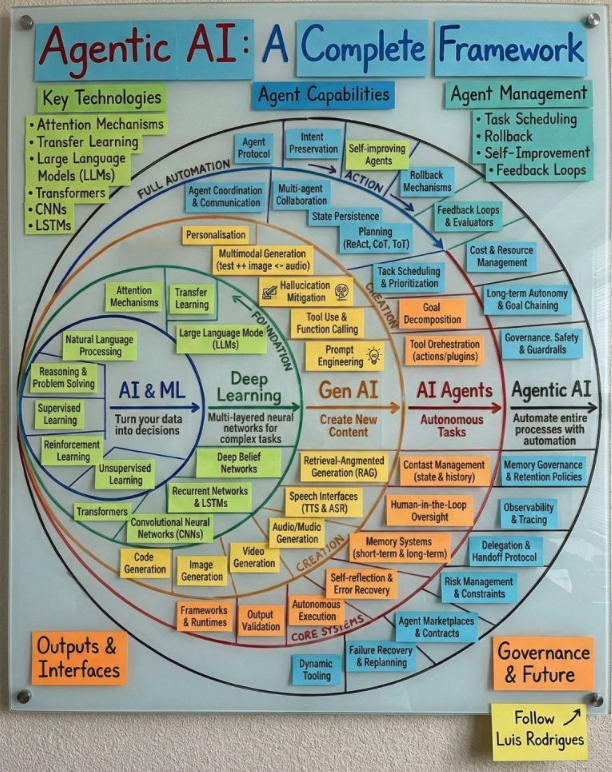
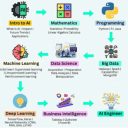
1. The Evolutionary Spectrum of Artificial IntelligenceThe progression of artificial intelligence is characterized by a shift from static, rule-bound systems to autonomous, non-deterministic execution environments. Each evolutionary phase introduces an additional layer of architectural and operational complexity. 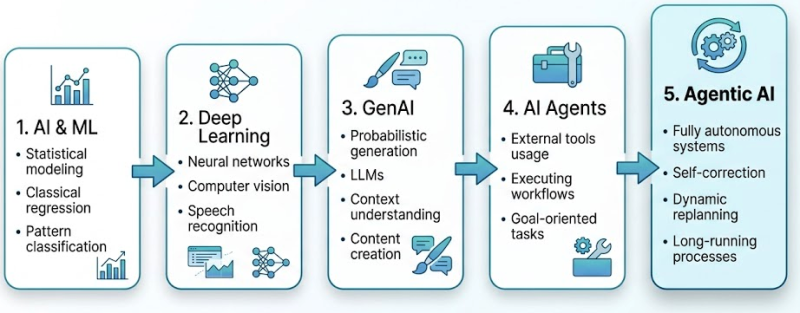
- Artificial Intelligence & Machine Learning (AI/ML): Statistical modeling, classical regression, and pattern classification operating on structured data.
- Deep Learning: Multi-layered neural networks enabling automated feature extraction, powering breakthroughs in computer vision and early natural language processing.
- Generative AI (GenAI): Large Language Models (LLMs) capable of understanding context, synthesizing information, and generating probabilistic text, code, and multimodal content.
- AI Agents: Systems capable of using external tools, maintaining short-term context, and executing discrete, multi-step workflows based on defined instructions.
- Agentic AI: Fully autonomous, stateful, and dynamic multi-agent systems operating over long time horizons with native self-correction, dynamic replanning, and enterprise-grade infrastructure integration.
2. Technical Capabilities Across the AI GenerationsMoving from basic Generative AI to Agentic AI requires shifting focus from prompt-level optimization to complex operational design. 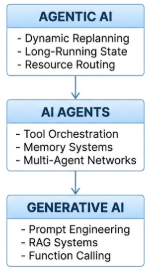
Generative AI Fundamentals- Prompt Engineering: Designing structured inputs to guide model output formatting and reasoning paths.
- Retrieval-Augmented Generation (RAG): Combining static parametric memory (model weights) with non-parametric memory (external vector databases) to reduce hallucinations.
- Function Calling: Structuring model outputs into machine-readable formats (e.g., JSON schemas) for consumption by external APIs.
- Hallucination Mitigation: Using system prompts, temperature controls, and ground-truth validation to improve factuality.
- Multimodal Generation: Processing and cross-referencing text, audio, image, and video data streams simultaneously.
AI Agent Mechanics- Tool Orchestration: Dynamically selecting, parameterizing, and executing external software tools (APIs, web scrapers, code interpreters).
- Goal Decomposition: Breaking down complex, ambiguous goals into ordered, executable sub-tasks.
- Memory Architectures: Implementing short-term session context alongside long-term vector/graph databases to persist information across conversations.
- Human-in-the-Loop (HITL): Inserting manual review checkpoints for critical, irreversible, or high-risk actions.
- Multi-Agent Collaboration: Distributing specialized responsibilities across distinct agents (e.g., researcher, reviewer, executor).
Agentic AI Capabilities- Long-Running Task Execution: Maintaining continuous operation across hours, days, or weeks without losing operational context.
- Dynamic Replanning & Self-Correction: Evaluating intermediate results, identifying failures, and rewriting execution strategies in real time.
- State & Memory Management: Preserving execution graphs, variable states, and operational context across disjunct system sessions.
- Resource & Cost Management: Dynamically routing sub-tasks to different models based on latency, context window size, and cost per token.
- Autonomous Work Delegation: Spawning child agents dynamically to handle sub-tasks and integrating their outputs back into the primary workflow.
3. The Production Trust Paradigm: Engineering Around the ModelThe core hurdle in deploying autonomous systems is not model intelligence, but building reliable software infrastructure around probabilistic models. 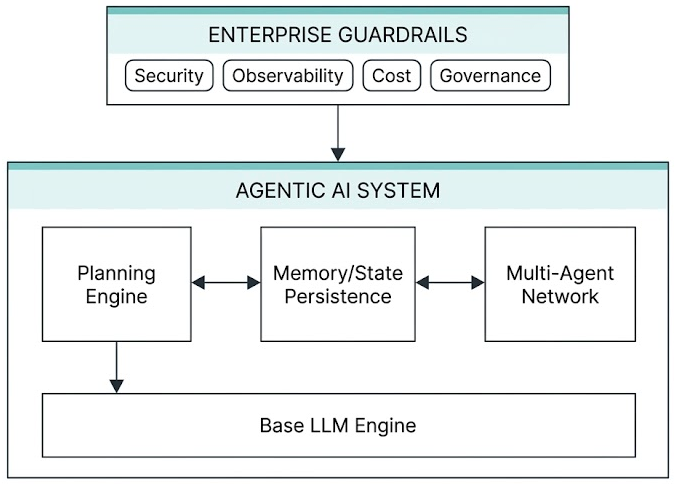
When an agent gains permission to execute actions—such as modifying databases, sending emails, or executing code—system security becomes the primary priority. Critical System Requirements- Security & Identity Management: Implementing strict Role-Based Access Control (RBAC), OAuth flows, and identity propagation so agents act strictly within user-defined authorization boundaries.
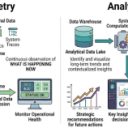
- Observability & Telemetry: Establishing step-level tracing for non-deterministic execution paths to trace decision lineage, input context, and API calls.
- Guardrails & Assertion Layers: Placing deterministic security layers between the LLM output and execution engines to intercept dangerous, invalid, or out-of-bounds operations.
- Governance & Compliance: Maintaining immutable audit logs of agent actions, ensuring data privacy compliance (GDPR, HIPAA), and tracking data provenance.
- Cost Control & Token Budgets: Implementing circuit breakers, timeout mechanisms, and usage limits to prevent infinite execution loops and unexpected API billing spikes.
- State Rollback & Failure Recovery: Designing transactional rollback capabilities to return databases and applications to safe states when an agent fails mid-task.
- Human Oversight Infrastructure: Building user interfaces that allow humans to pause agent execution, inject corrective guidance, and inspect proposed action plans before execution.
4. The Architectural Shift in AI EngineeringDeploying production-ready Agentic AI shifts the software paradigm from deterministic pipelines to non-deterministic, distributed state machines. 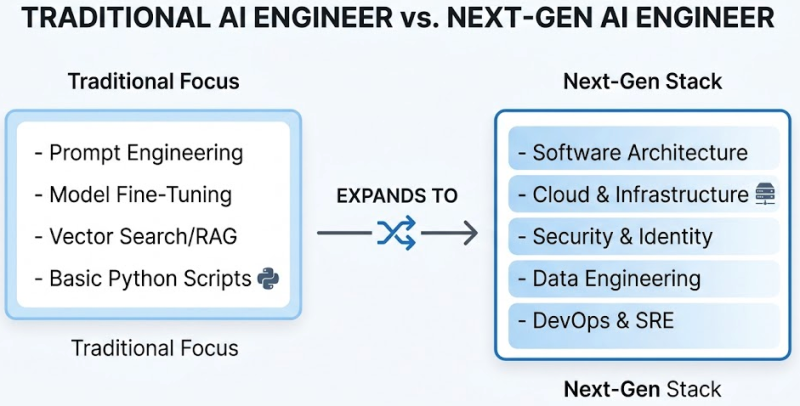
The Required Skill MatrixModern AI Engineering requires integrating traditional software development disciplines with AI systems: - Software Engineering: Microservice architectures, asynchronous handling, design patterns, and robust error management.
- Cloud & Infrastructure: Containerization (Docker, Kubernetes), serverless scaling, infrastructure as code (IaC), and secure sandboxed environments (e.g., eBPF, microVMs) for running agent-generated code.
- DevOps & Site Reliability Engineering (SRE): Continuous Integration/Continuous Deployment (CI/CD) pipelines for prompts and models, system uptime monitoring, latency optimization, and automated fallback orchestration.
- Security Engineering: Threat modeling for prompt injection, context contamination, privilege escalation, and zero-trust access management.
- Data Engineering: Real-time data pipeline construction, streaming analytics, vector database tuning, and transactional graph persistence.
- AI Science & Orchestration: Model evaluation, prompt topologies, fine-tuning, context window management, and multi-model deployment strategies.
Production-grade Agentic AI is an enterprise software architecture problem. The underlying model acts as an inference engine, but system stability, security, and governance dictate enterprise success. |