The Cybercab Transformation: From Autonomous Taxi to Mobile Base Station
JK 2022 Created at
37300
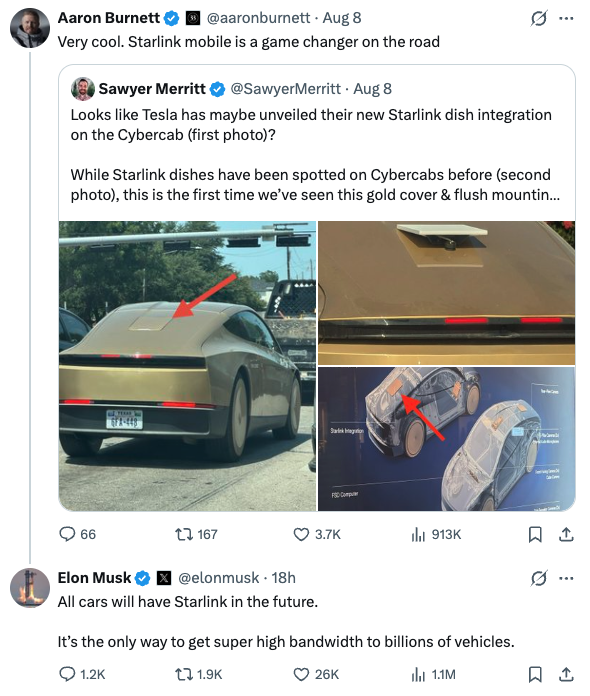
An interesting post appeared on Twitter today, saying that every Cybercab will be equipped with a Starlink satellite antenna...
Integration of Starlink and Cybercab Infrastructure
The mounting of Starlink antennas on Tesla Cybercabs shifts the concept of an autonomous vehicle from a simple transport unit to a connected data hub.
Seamless Architectural Integration: Cybercabs utilize flat, high-performance Starlink antennas designed specifically for mobility. These antennas are flush-mounted into the vehicle's roof or bodywork, maintaining aerodynamic efficiency while preserving high data throughput.
Continuous High-Speed Connectivity: By connecting directly to Space-X’s Low Earth Orbit (LEO) satellite constellation, Cybercabs eliminate dependency on traditional terrestrial cellular networks, overcoming regional dead zones, signal throttling, and network blackouts.
Real-Time FSD Data Processing: Autonomous operation demands vast amounts of real-time spatial and sensor data. Starlink enables instantaneous transfer of full-resolution video streams, fleet telemetry, and edge-computing data back to centralized AI training clusters.
How Cybercabs Act as Decentralized Communication Nodes
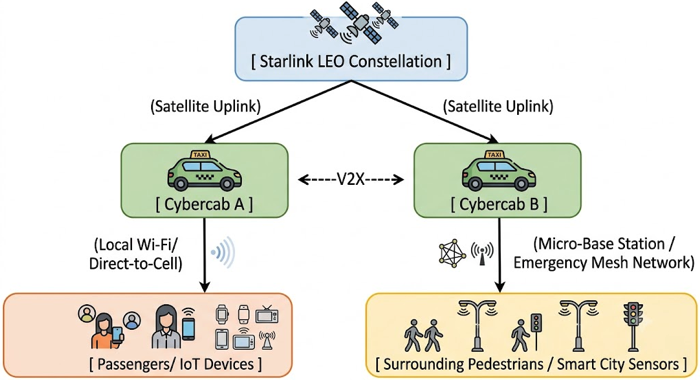
Equipping thousands of Cybercabs with satellite uplinks transforms the autonomous fleet into a dynamic, mobile mesh network operating as decentralized micro-base stations.
1. Dynamic Mobile Hotspots
Local Wi-Fi and Cellular Relays: Each Cybercab can broadcast high-speed local Wi-Fi or local cellular frequencies to passengers and nearby pedestrians, turning a parked or moving cab into a localized cell tower.
Offloading Terrestrial Traffic: In high-density urban areas or during large events (concerts, games), a concentration of Cybercabs can relieve congested local cell towers by routing data traffic directly to space.
2. Vehicle-to-Everything (V2X) Mesh Networking
Peer-to-Peer Inter-Vehicle Relay: Cybercabs can communicate directly with one another over localized short-range frequencies. If one vehicle loses direct satellite line-of-sight (e.g., inside a tunnel or urban canyon), it can relay its signal through a nearby Cybercab.
Collaborative Fleet Intelligence: Vehicles share ultra-low-latency data regarding road hazards, traffic congestion, and weather conditions, building a collective real-time map of the physical environment.
3. Emergency and Remote Network Resilience
Disaster Recovery: In times of natural disasters where ground-based cell towers are destroyed, a deployment of Cybercabs can restore basic telecom services, emergency dispatch comms, and internet access to affected areas immediately.
Rural Coverage Expansion: Cybercabs operating in underserved, remote regions automatically extend connectivity infrastructure without requiring expensive fixed tower investments.
Elon Musk’s Vision for the Next-Generation Global Network
Elon Musk’s broader strategy aims to build an integrated, multi-layered communication and computing ecosystem spanning space, ground, and hardware assets.
1. Space-to-Ground Heterogeneous Network
Musk is merging Starlink's space infrastructure with Tesla's terrestrial fleet infrastructure. The goal is a universal network where any device—whether a Tesla, an Optimus humanoid robot, a smartphone, or an IoT sensor—remains perpetually connected to a single high-bandwidth, low-latency framework regardless of geographical location.
2. Direct-to-Cell and Distributed Edge Compute
Direct-to-Cell Technology: Starlink satellites are evolving to connect directly to standard mobile phones without custom hardware. Cybercabs serve as high-power ground-level relay stations that amplify and route these direct-to-cell signals in dense environments.
Distributed Compute Network: Cybercabs contain powerful onboard AI chips (HW4/HW5). When idle or charging, these vehicles can pool their computational power over the Starlink network to operate as a massive, distributed supercomputer for xAI (Grok) or neural network processing.
3. Vertical Integration Across Ecosystems
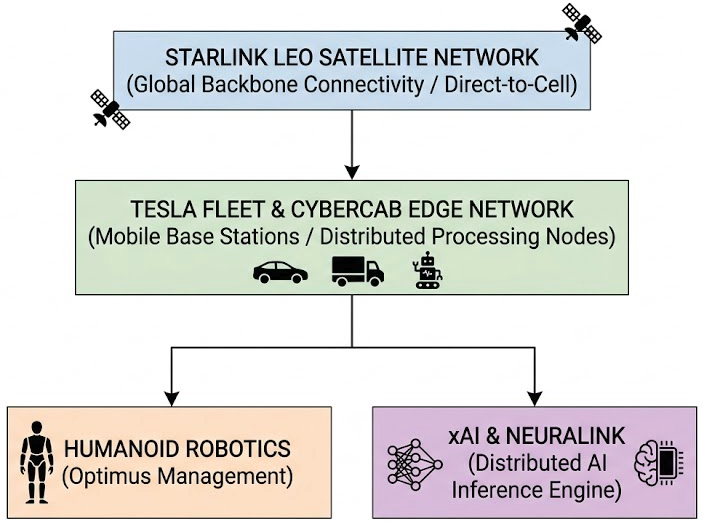
By controlling every tier of the technological stack—SpaceX (launch & satellites), Tesla (EVs, Cybercabs, Optimus), xAI (artificial intelligence), and Neuralink (brain-computer interfaces)—Musk creates a self-sustaining loop:
SpaceX provides global bandwidth.
Tesla Fleet provides localized mobile hardware infrastructure and power grid storage.
xAI & Neuralink provide the intelligent data processing layers running across the network.
Strategic Advantages and Future Impact
Feature
Traditional Network Model
Musk's Integrated Cybercab/Starlink Model
Infrastructure
Static cell towers, high real-estate costs
Dynamic, self-deploying mobile nodes
Coverage Dead Zones
Common in remote, oceanic, or rural areas
Zero dead zones; direct satellite line-of-sight
Disaster Resilience
Vulnerable to physical infrastructure damage
Instantly recoverable via dynamic satellite/car topology
Data Monetization
Utility-based carrier plans
Platform model combining transport, internet, and AI services
Reduced Operating Costs: Tesla eliminates expensive third-party cellular data contracts (e.g., AT&T, Verizon) for its global vehicle fleet, reducing operating expenses for autonomous operations.
Teleoperation Security: Autonomous fleets require fail-safe teleoperation (remote human override). Dual-layer connectivity via mobile mesh and direct satellite links guarantees a reliable, non-interruptible stream for remote safety monitors.
New Revenue Streams: Cybercabs can monetize connectivity by acting as mobile data vendors, selling high-speed access to passengers, smart city developers, and telecom partners.