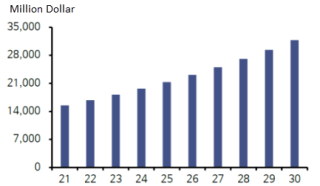
| The global robot industry market size is steadily on an upward trend. The service robot market is expected to reach $32.7 billion in 2024 and $47.5 billion in 2026, while the industrial robot market is projected to reach $21.3 billion in 2024 and $26.6 billion in 2026. This represents an average annual growth rate of approximately 17%. According to the International Federation of Robotics (IFR) market outlook, the global manufacturing robot market is also expected to exhibit a long-term upward trend. The market is anticipated to expand from $19.7 billion in 2024 to $31.8 billion in 2030, with an average annual growth rate of approximately 8.3%. 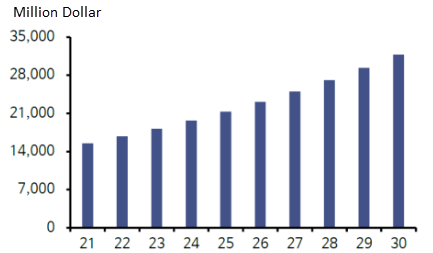
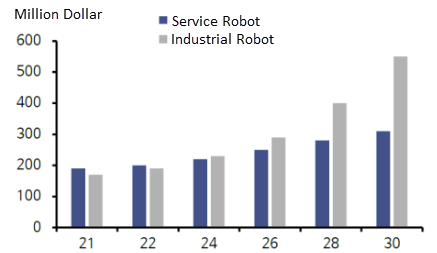
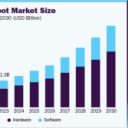
The global industrial robot installation count is projected to exceed 700,000 units after 2026, increasing from 622,000 units in 2024 to 662,000 units in 2025 and 718,000 units in 2026. The robot industry can be broadly categorized into manufacturing robots, service robots, robot components, and software. The demand for service robots, including medical robots, is expected to significantly increase in the future. The manufacturing robot market is also expected to experience substantial growth to fill the labor gap caused by low birth rates and an aging population. Japan (components) and the United States (software) dominate the robot component and software sectors. Professional service robots encompass service robots utilized in diverse fields such as medical, defense, agriculture, logistics, and manufacturing (assembly, packaging, quality control, etc.). Operators require a certain level of knowledge to operate these robots. The professional service robot market is projected to grow from $20.7 billion in 2022 to $109.1 billion in 2029 at a compound annual growth rate (CAGR) of 27%. The medical robot market is expected to continue expanding, growing from $11.5 billion in 2023 to $52.1 billion in 2030 with an annual CAGR of 24%. Medical robots are categorized based on product lines as surgical robots, telepresence robots, rehabilitation robots, and others, and by application as cardiac, orthopedic, laparoscopic, neurosurgical, and pharmaceutical robots. In 2023, the product-wise market share of medical robots is 66% for surgical robots, 10% for telepresence robots, 20% for rehabilitation robots, and 4% for others. Geographically, the market composition is approximately 46% North America, 22% Asia Pacific, 15% Europe, 7% Middle East/Africa, and 10% South America. The surgical robot market is expected to reach $119.3 billion in 2030, growing from $69.6 billion in 2023.
Other Areas in Robotics Industry:
- Market Drivers: Several factors are driving the growth of the robot market, including:
- Labor shortages: Aging populations and declining birth rates are leading to labor shortages in many countries, creating demand for robots to fill those gaps.
- Automation and efficiency: Robots can perform tasks more efficiently and accurately than humans, leading to cost savings and increased productivity.
- Technological advancements: Advancements in artificial intelligence (AI), robotics, and sensor technologies are making robots more sophisticated and capable.
- Increased demand for customized products: Robots are increasingly being used to produce customized products and meet consumer demand for personalization.
- Key Market Trends:
- Growing adoption of collaborative robots (cobots): Cobots are designed to work safely alongside humans, making them suitable for tasks that require human interaction.
- Increasing use of robots in healthcare: Medical robots are being used for a wide range of applications, including surgery, rehabilitation, and patient care.
- Focus on robotics in the automotive industry: Robots are widely used in automotive manufacturing and are expected to play an even greater role in the future.
- Major Players:
- ABB: A leading provider of industrial robots and automation solutions.
- Fanuc: A major manufacturer of industrial robots, CNC systems, and factory automation equipment.
- KUKA: A global supplier of industrial robots, automation systems, and software.
- Yaskawa: A Japanese company known for its industrial robots, motion control systems, and robotics software.
- Challenges:
- High initial costs: Robots can be expensive to purchase and install.
- Technical complexity: Implementing and maintaining robots requires specialized expertise.
- Ethical concerns: There are concerns about job displacement, safety, and the ethical implications of using robots in certain industries.
Key Takeaways: Global Robot Market Outlook
- The global robot market is experiencing significant growth, with both service and industrial robot sectors expected to expand at double-digit annual rates.
- The demand for robots is driven by factors like labor shortages, automation needs, technological advancements, and growing customization demands.
- Service robots, particularly in the medical field, are projected to see substantial growth, driven by the increasing need for healthcare solutions.
- The manufacturing robot market is also expanding rapidly, with advancements in collaborative robots (cobots) playing a key role.
- The automotive industry remains a major user of robots, and this trend is expected to continue.
- While the robot market is experiencing rapid growth, challenges remain, including high initial costs, technical complexity, and ethical concerns.
|