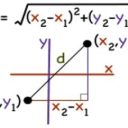
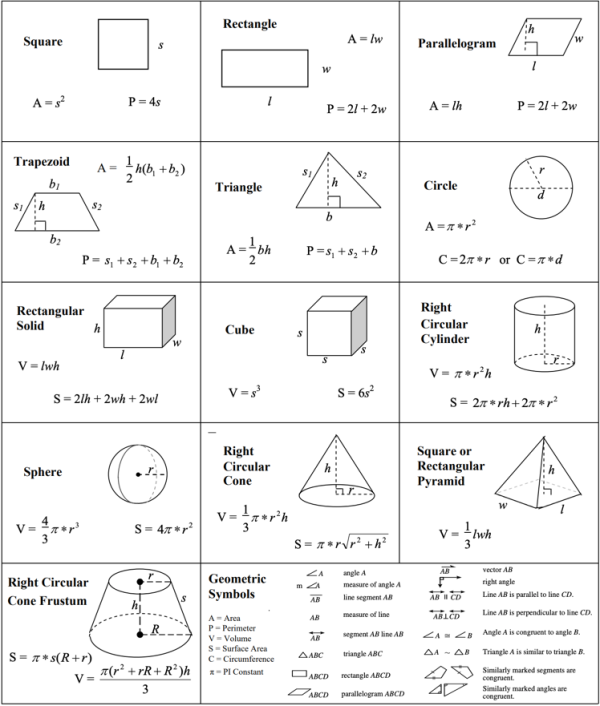
| Today, we're diving into the world of shapes, sizes, and dimensions with some basic geometry formulas. Now, I know geometry might not sound as flashy as algebra, but trust me, it's like the stealth ninja of mathematics. Let's explore why these formulas are so important and how they can unlock a whole new way of looking at the world. First things first, let's talk about what geometry actually is. It's like the Sherlock Holmes of mathematics, investigating the properties and dimensions of shapes, sizes, and spaces. There are three main types of geometry: Euclidean, Spherical, and Hyperbolic. Each one has its own unique set of rules and formulas, but today, we'll focus on the basics of Euclidean geometry in two and three dimensions. So, why should you care about geometry formulas? Well, let me tell you, they're like the Swiss Army knife of problem-solving. Here's why they're so important: Problem Solving: - Geometry formulas provide a systematic way to calculate dimensions, areas, volumes, and other properties of geometric shapes and figures. Whether you're figuring out how much wallpaper you need for your bedroom or calculating the volume of a swimming pool, geometry has your back.
Understanding the Physical World: - From the architecture of buildings to the design of bridges and machines, geometry helps us understand and analyze the world around us. Want to build a sturdy bridge that won't collapse under pressure? You'll need to know your geometry.
Foundational for Advanced Mathematics: - Geometry lays the groundwork for more advanced fields of mathematics like algebra, calculus, and topology. Understanding geometric concepts is crucial for higher-level mathematical reasoning and problem-solving.
Critical Thinking and Reasoning: - Deriving and applying geometric formulas enhances logical reasoning, critical thinking, and problem-solving skills. It requires an understanding of abstract concepts and the ability to apply them to real-world problems.
Applications in Technology and Science: - Geometry plays a crucial role in fields like computer graphics, robotics, physics, engineering, and architecture. Ever wondered how CGI effects are created in movies or how robots navigate through space? Geometry is the answer.
Interdisciplinary Connections: - Geometry isn't just confined to mathematics; it connects with other disciplines like art, architecture, physics, and biology. It helps us understand the structure and dynamics of everything from microscopic crystals to the vast expanses of the universe.
So, the next time you're staring at a geometric shape or scratching your head over a problem, remember this: geometry and its formulas are your secret weapons for understanding and navigating the world around you.
 |